
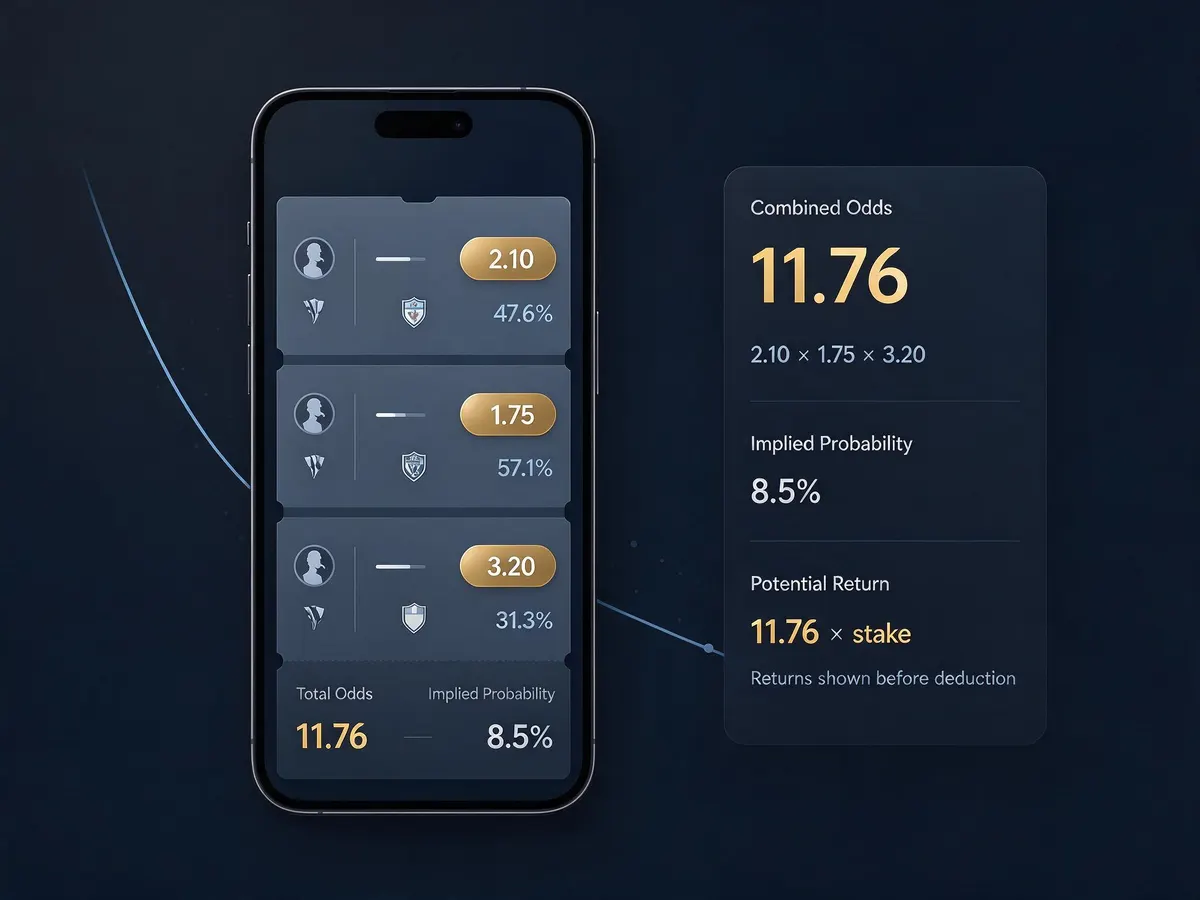
The number that explains why your betting slip looks different
A study of 547 million NFL wagers placed between 2018 and 2023, published in Finance Research Letters in September 2026, found that parlays grew from roughly a third of all bets to 72.51% of them. Single-leg bets fell to 27.49%. The researchers also found this wasn’t just new customers arriving with new habits — existing bettors changed how they wagered.
So the appeal of multi-leg betting is not in doubt. The arithmetic behind it is less widely understood. The difference between single bets vs parlays isn’t a matter of taste or confidence; it’s a measurable trade-off between payout size, win probability and how much of your stake the bookmaker expects to keep. Here is how that trade-off actually works.
What each bet type is
A single bet is one wager on one outcome. You back India to beat Sri Lanka at decimal odds of 1.50, stake ₹1,000, and if India win you get ₹1,500 back (₹500 profit). One selection, one result, done.
A parlay combines two or more selections into a single wager. Every selection — each one is called a leg — has to win. If one leg loses, the whole bet loses, regardless of how the others finished. Indian sportsbooks and their European parents use several names for the same thing: accumulator, acca, multi, combo, or treble and fourfold for specific sizes. The mechanics don’t change with the label.
Parlay odds explained: you multiply, you don’t add
The first misconception worth clearing up is that a parlay’s odds are some kind of generous bonus the bookmaker hands out for taking on extra risk. They aren’t. They’re just multiplication.
The multiplication effect
To price a parlay, the sportsbook multiplies the decimal odds of every leg together. Three legs at 2.00, 1.80 and 2.20 become:
2.00 × 1.80 × 2.20 = 7.92
A ₹1,000 stake returns ₹7,920 if all three land. That looks dramatic next to three separate singles. The problem is that probability multiplies in exactly the same way, just in the opposite direction.
A worked example with the probabilities attached
Convert each leg to its implied probability (1 ÷ decimal odds):
- 2.00 → 50%
- 1.80 → 55.6%
- 2.20 → 45.5%
Multiply those three figures and you get 12.6%. Divide 1 by the combined odds of 7.92 and you get the same 12.6%. That’s not a coincidence — it’s the whole point. The parlay pays more because it is less likely to win, by precisely the same factor.
One technical caveat: multiplying probabilities like this assumes the legs are independent events. Selections from the same match usually aren’t. A team winning and its star batsman scoring runs tend to move together, which is why same-game parlays are priced separately rather than by simple multiplication.
Myth: a four-leg parlay is only slightly harder than a three-leg
This is where intuition fails most reliably. Adding a leg feels like a small change to the slip. It isn’t a small change to the maths.
Win probability, leg by leg
Take four legs you genuinely rate as 70% chances each. The parlay’s chance of winning is 0.70 × 0.70 × 0.70 × 0.70 = 24%. Four selections you’d describe as likely combine into an outcome that fails three times out of four. Stretch it to six legs at 70% and you’re down to 11.8%.
Shorter prices soften the fall but don’t stop it. Five legs at 1.20 each (83.3% implied) multiply to about 40% — the parlay pays 2.49 and loses more often than it wins.
The curve gets steep fast
So no, parlays aren’t marginally harder to win than singles — they’re harder by a compounding factor. Each leg you add multiplies your win probability by a number smaller than one. That is the definition of exponential decay, and it is why “are parlays harder to win” has a short answer: substantially, and increasingly so with every selection.
Betting risk comparison: where the house edge compounds
Lower win probability with proportionally higher payouts would be a fair swap. It isn’t quite a fair swap, because every leg carries the bookmaker’s margin, and those margins multiply too.
Expected value, side by side
Picture a market priced 1.90 on both sides — a standard two-way price. Implied probability is 52.6% per side, 105.3% in total; that extra 5.3 points is the overround. If the real chance of each outcome is 50%, your expected return on a ₹100 single is 0.50 × ₹190 = ₹95. You expect to lose ₹5, or 5%.
Now stack those same legs into parlays. The expected return per ₹100 is simply 95% multiplied by itself once per leg:
| Legs (each at 1.90) | Combined odds | True win chance | Expected return per ₹100 | Expected loss |
|---|---|---|---|---|
| 1 | 1.90 | 50% | ₹95.00 | 5.00% |
| 2 | 3.61 | 25% | ₹90.25 | 9.75% |
| 3 | 6.86 | 12.5% | ₹85.74 | 14.26% |
| 4 | 13.03 | 6.25% | ₹81.45 | 18.55% |
| 5 | 24.76 | 3.125% | ₹77.38 | 22.62% |
A 5% edge per leg becomes a 22.6% expected loss across five legs. The payout grows linearly in appearance and the cost grows with it. This is the honest answer to why parlays pay more: not because the sportsbook is being generous, but because the combined outcome is rare, and the price of that rarity includes the margin from every leg you added.
What variance does to a bankroll
Expected value tells you the long-run direction. Variance tells you how bumpy the ride there is, and parlays are considerably bumpier.
Run ₹100 across 100 single bets at 1.90 and your turnover is ₹10,000 with an expected loss of around ₹500. Run the same ₹10,000 through 100 three-leg parlays and the expected loss is roughly ₹1,430 — nearly three times as much, from the same money.
The distribution matters as much as the average. A 12.5% win rate means a 26% chance of losing ten consecutive parlays and about a 7% chance of losing twenty in a row. Those streaks are normal, not unlucky, and they’re the reason bankroll management advice for multi-leg betting always points at smaller stakes: the format produces long droughts punctuated by occasional large returns, and a stake sized for singles will not survive the droughts.
Combined bet payouts: three singles against one treble
Here’s a concrete comparison using plausible short-priced selections — an IPL favourite at 1.80, a football favourite at 1.60 and an ODI favourite at 1.50. Those multiply to 4.32, an implied win chance of 23.1%.
Two approaches, both staking ₹1,500 in total: three singles of ₹500, or one ₹1,500 treble.
| Result | Three ₹500 singles | One ₹1,500 treble at 4.32 |
|---|---|---|
| All three legs win | ₹2,450 returned (+₹950) | ₹6,480 returned (+₹4,980) |
| Two legs win (1.80 and 1.60) | ₹1,700 returned (+₹200) | ₹0 (−₹1,500) |
| One leg wins (1.80) | ₹900 returned (−₹600) | ₹0 (−₹1,500) |
| No legs win | ₹0 (−₹1,500) | ₹0 (−₹1,500) |
The treble’s upside is more than five times the singles’ upside. It is also the only line in that table where being two-thirds right pays anything at all. Singles give you partial credit; parlays don’t recognise the concept.
Reading your own slip honestly
Neither format is a system, and neither beats the margin — the house edge is built into both, and it is larger in the parlay. What the maths does let you do is describe your own bet accurately before you place it: this is a 23% shot paying 4.32, not three likely results in a row.
If you bet multis, size them for a win rate in the low double digits or worse, and treat the cost as entertainment spending rather than expected income. Deposit limits, loss limits and session reminders exist at every licensed sportsbook, and they’re more useful than any staking plan. If betting has stopped being a hobby, use the self-exclusion tools or contact a free support service — that’s the one piece of advice here with no arithmetic attached.