
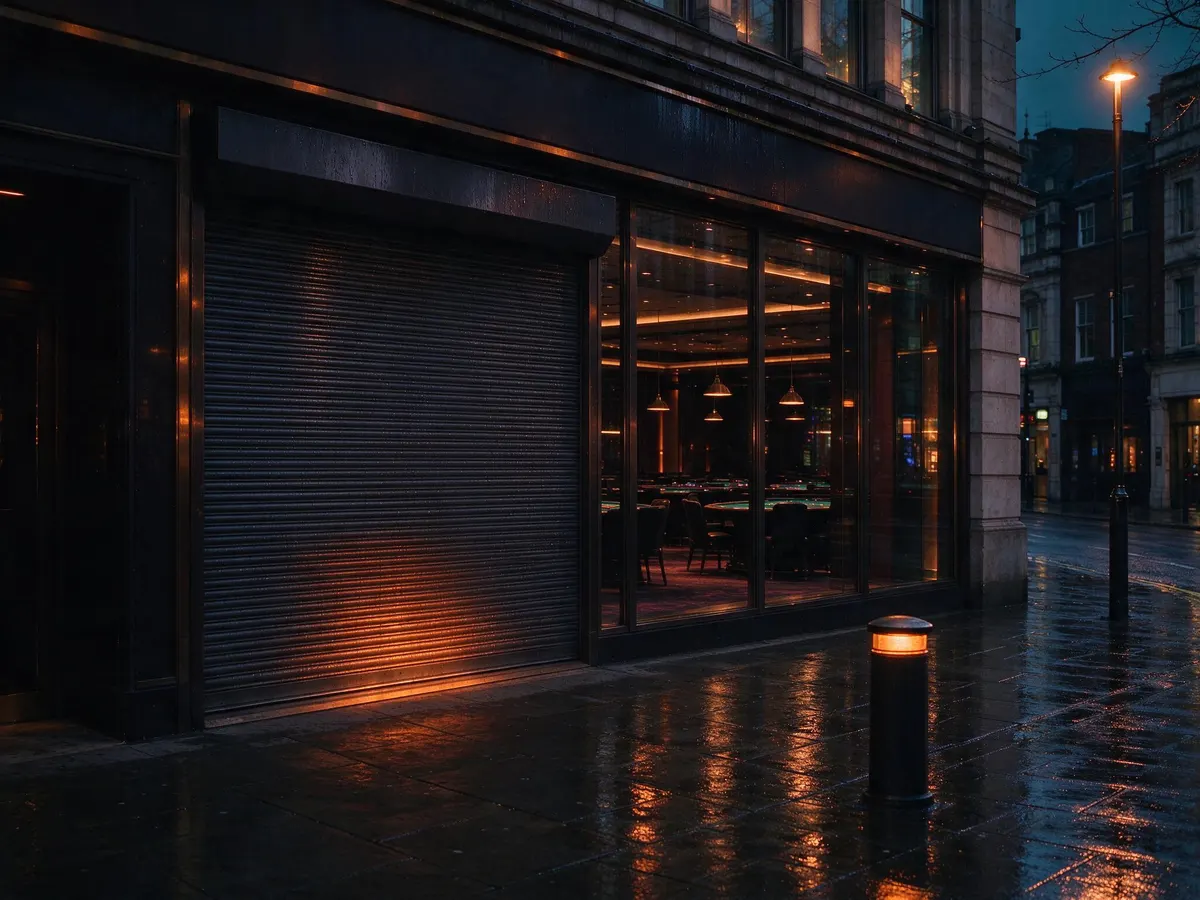
The lights are already off at Grosvenor Casino in Swansea. The venue has ceased operations, and it now sits in the background of a much bigger argument about how Britain taxes gaming machines. Nobody has shown that one specific closure was caused by tax policy, so don’t read it that way. But it’s the picture the industry is pointing at while it argues about a number: 40.
What the proposed machine games duty increase actually is
The proposal under debate would raise Machine Games Duty to 40 per cent, and the Betting and Gaming Council says that would put up to 3,800 casino jobs at risk, with some operators weighing the closure of as much as a third of their estates. Britain’s casinos directly employ more than 10,000 people, so the warning covers a meaningful slice of the whole workforce.
That framing matters. This isn’t a story about operators making slightly less margin. The claim on the table is that a single rate change flips venues from marginal to unviable, and that once a casino closes it does not reopen when the rate changes back.
Why a duty on takings bites harder than a tax on profit
Machine Games Duty is charged on net takings from machine play, meaning stakes received minus prizes paid out, and it is owed whether or not the venue made money that year. That is the structural reason the industry calls a hike existential rather than painful. Corporation tax takes a share of profit. A duty on takings takes its share first, and the rent, the staff rota, the compliance team and the electricity bill all come after.
Here is where the evidence runs out, and I’d rather say so than paper over it. The industry warning names the 40 per cent destination; it does not set out the baseline band rates it is measured from, and casino machine play has historically sat in a different band from low-stake pub machines. So if you see a confident “that’s a doubling” or “a 15-point jump” quoted somewhere, check what band the writer is actually using. The honest statement is narrower: 40 per cent of net machine takings, on a business whose fixed costs are mostly staff and property.
Three ways an operator can respond, and who pays for each
A tax on takings leaves a venue operator with a short menu. None of the options are free, and the differences between them are mostly about who notices.
| Response | Who absorbs the cost | What you would notice as a customer |
|---|---|---|
| Absorb it from margin | Shareholders, reinvestment budgets | Little at first; tired venues, fewer refurbishments later |
| Cut operating costs | Staff, hours, hospitality side | Shorter opening hours, thinner floor staffing, trimmed food and drink |
| Close the weakest venues | Employees and local economies | Your nearest casino is no longer your nearest casino |
| Change the machine product mix | Players, through worse value | Tighter game selection and a less generous mix on the floor |
The fourth option is the one players should understand properly, because it is the quietest. Every machine game has a stated return to player, and the house edge is simply the remainder: a 92 per cent RTP game keeps 8 per cent of turnover over the long run against 4 per cent for a 96 per cent game. Operators choosing a lower-RTP mix within whatever their licence conditions permit is not cheating anyone, and it does not change anyone’s odds on a given spin. It does change what the floor returns over thousands of sessions, and it is invisible unless you read the game information screens.
The verdict on that menu, on the figures as published: closures are the response the industry says it is modelling, and they are also the one with no reverse gear. Margin can be rebuilt. A shuttered casino in a secondary city centre becomes a retail unit.
Where the closures would land
Half of all threatened closures would fall in the North of England and Scotland, accounting for around 1,900 of the jobs at risk. The regional split is the part of this story that gets lost when it’s reported as a Westminster tax row.
| Region | Share of threatened closures | Jobs at risk |
|---|---|---|
| North of England and Scotland | About half | Around 1,900 |
| Midlands | 20 per cent | Not broken out in the published figures |
| London | 10 per cent | Not broken out in the published figures |
Those three lines account for roughly 80 per cent of the threatened closures. The remainder is not allocated in the figures the Betting and Gaming Council has put out, so treat the table as what it is: a partial geography, not a complete map. What it does establish is direction. The exposure is concentrated outside London, in the kind of city-centre venue that employs part-time and shift workers, people starting out in hospitality, and people who have built long careers in leisure.
What it means if you mostly play online
Land-based machine duty does not land on your online account, but the two markets are connected through product and through policy precedent. Remote gaming is taxed under its own duty regime, separate from Machine Games Duty, and the rate debate for one inevitably shapes the political arithmetic for the other. If the Treasury concludes that gaming taxes can be raised steeply without reducing receipts, that conclusion doesn’t stay in one category.
The behavioural point is reasoning rather than data, and I’ll label it as such: when machine play in venues becomes scarcer or worse value, some of that play does not disappear, it moves. Some goes to regulated online slots. Some goes to unlicensed offshore sites, where there is no duty, no UK licence condition, no deposit limit you can set and no regulator to complain to. That is the migration risk in UK gambling regulation that a revenue forecast is poor at capturing, and the source material does not quantify it. Nobody should pretend to.
The question the figures don’t settle
There are two numbers in this argument and only one of them is public. The industry has put a figure on the damage: 3,800 jobs, a third of some estates, a regional split weighted away from London. What has not been laid alongside it is a reconciled estimate of what a 40 per cent rate would actually collect once you subtract the duty, business rates, VAT and payroll taxes that closed venues stop paying. Until those two sets of arithmetic are compared in the open, “existential threat” and “fair contribution” are both assertions.
If you play machines in a British casino, the practical move is unglamorous: check the return to player information on the games you actually use, notice if the floor mix shifts, and keep your own limits in place regardless of what the tax rate ends up being. Gambling carries a built-in house edge in every direction, and that edge does not care what the Chancellor decides. Set deposit and time limits, and use the operator’s cool-off tools or GamCare if play stops feeling like a choice.