
A salsa singer at the roulette table
At Seminole Hard Rock Hotel & Casino Hollywood in Florida, the launch of a new gaming area opened with Willy Chirino leading a celebration at a roulette table, while Grammy-nominated salsa star Frankie Negron and Cuban-born rapper Luke Taleno worked the crowd at a blackjack table. The dealers spoke Spanish and English. The table felts were printed in both languages. Nobody had changed a single rule of roulette.
That gap between what changes and what doesn’t is the whole subject. Themed slot games, and themed casino spaces generally, are built on a simple division of labour: the art, audio and story do the persuading, and the math underneath stays exactly as the regulator approved it. Understanding which half you’re looking at makes you a much better reader of a casino floor.
The problem: most slot themes are wallpaper
Walk any floor and you’ll see dozens of cabinets with different faces running recognisably similar games. Same reel grid, same expanding wild, same “hold and spin” bonus with coin values on the symbols. The theme has been painted on after the math model was finished, which is why so many themed games feel interchangeable after ten spins.
This happens for structural reasons. Math models are expensive to certify and get reused across titles. Art is comparatively cheap to swap. A studio with a performing math engine can ship several skins from it in a year, and commercially that’s rational. It just means the honest question about any themed game isn’t “does it look good” but “does the theme actually touch the mechanics, or is it a costume?”
How casinos and studios choose a theme
Theme selection is a commercial decision dressed up as a creative one. Studios and operators tend to weigh a handful of things.
- Recognition without explanation. A theme has to read from six feet away, on a sign or a cabinet topper, with no instructions. Cultural celebrations, mythology, fruit, Egypt and fishing all pass that test.
- Licensing cost versus pull. A branded music or film licence buys instant familiarity and takes a cut of the economics. Cultural and heritage themes are usually unlicensed, which is part of their appeal to operators.
- Shelf life. A theme tied to one event has a short run; a theme tied to a community can be refreshed every year. Annual celebrations like Hispanic Heritage Month sit neatly in the middle, with a calendar peak and a year-round audience.
- Art feasibility. Some themes animate beautifully on a tall curved cabinet. Others look cramped.
Research that goes beyond mood boards
Cultural theming carries a risk that fruit machines don’t: getting it wrong in public. The serious version of this work involves consulting people from the culture being represented, checking that symbols aren’t sacred or politically loaded, getting language and typography reviewed by native speakers, and commissioning music from musicians who actually play the genre rather than a library approximation of it. The lazy version reaches for sombreros and maracas and gets written about for the wrong reasons.
Internal staff are an underused resource here. At the Seminole Hard Rock property, nearly 35% of team members identify as being of Latin descent, which is a research panel sitting on the payroll.
Who the game is actually for
Operators plan themed launches against player data they already hold: loyalty card activity, denominations played, time of day, whether a zone draws locals or hotel guests, and which existing games over-index with which groups. That analysis decides placement as much as art direction. A theme aimed at a community that plays Friday and Saturday evenings gets scheduled and staffed accordingly, not left to compete with a Tuesday afternoon crowd.
Slot design features that carry a theme
Three layers do the work, and they’re usually built by different people.
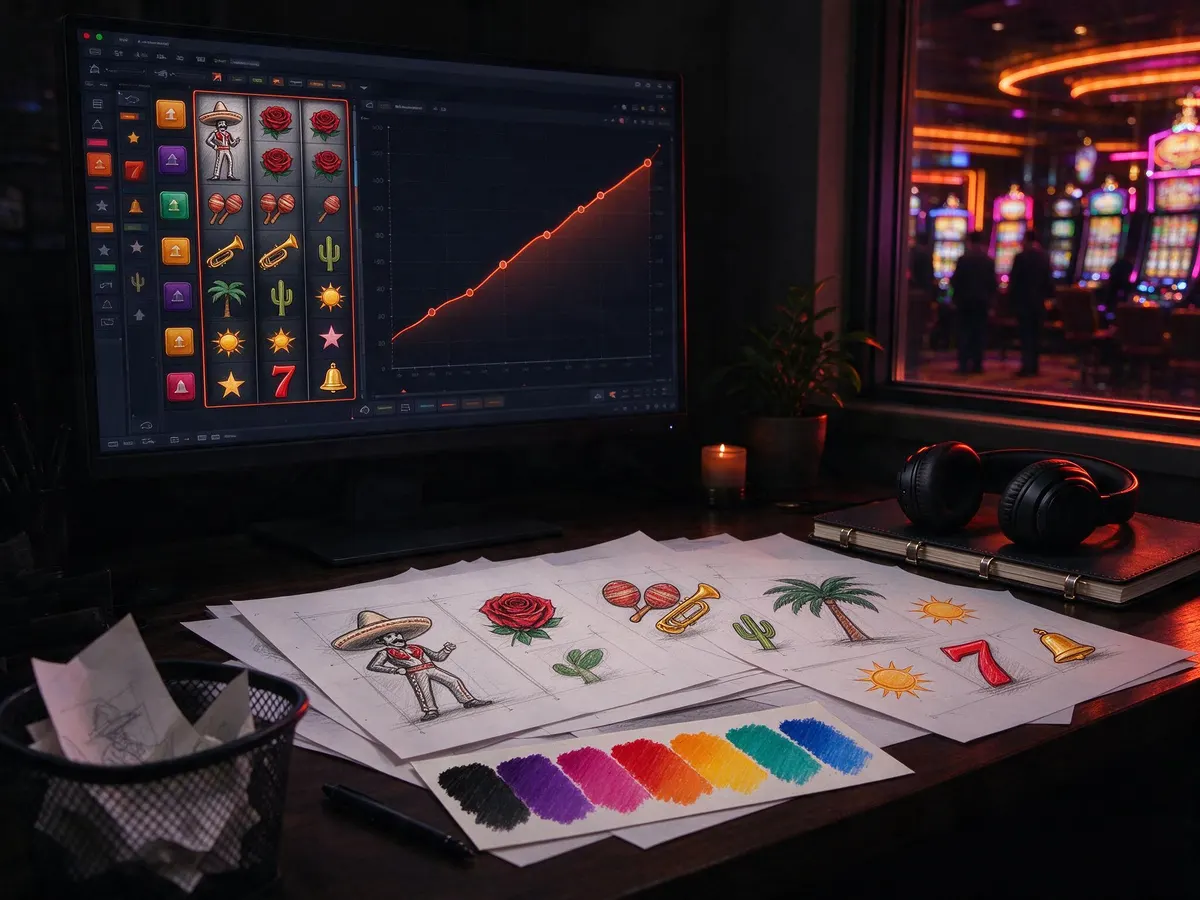
Visual design. Symbol hierarchy comes first: low-pay symbols (often card ranks or simple objects) need to be legible and forgettable, while high-pay symbols carry the theme’s identity. Then colour palette, background art, win animations and the reel frame itself. Good themed art uses motion to tell you what matters, with near-miss and big-win animations scaled to the actual size of the result.
Sound. Audio does more theming per dollar than graphics. A reel-stop sound, a rising arpeggio during anticipation spins, a distinct bonus-trigger sting, live instrumentation instead of synthesised stand-ins. Floors are loud, so music is often mixed to be felt at close range and ignored at ten feet.
Bonus feature naming and framing. This is where theme and mechanics meet. Calling a free spins round a “fiesta round” is decoration. Building a feature whose structure reflects the theme, say a bonus where symbols collect across several stages like courses of a meal, is theming that changes how the game plays.
Zona de Fuego: theming at floor scale
The Seminole Hard Rock launch is a useful case study precisely because it isn’t a slot machine. Zona de Fuego is billed as Florida’s first fully integrated Latin gaming and entertainment experience, previewed during the Hollywood resort’s Hispanic Heritage Month celebration. Worth keeping the properties straight here: the “My Rhythm. My Flavor. ¡Mi Gente!” theme belongs to Seminole Hard Rock Tampa’s Hispanic Heritage Month celebration, not the Hollywood property’s Zona de Fuego launch. The design logic is the same as a themed game’s, applied to a physical zone.
The gaming itself is familiar. Nine bilingual tables offer Spanish 21, blackjack, roulette, Casino War, Double Down Madness and Ultimate Texas Hold’em. Spanish 21 is the only game on that list with an inherently Latin label, and it’s a blackjack variant that has been on American floors for decades. What’s been rebuilt is everything around the games.
| Element | How it was executed |
|---|---|
| Table games | Nine bilingual tables: Spanish 21, blackjack, roulette, Casino War, Double Down Madness, Ultimate Texas Hold’em |
| Staffing | Bilingual dealers engaging guests in English and Spanish |
| Physical design | Memorabilia from Latin music stars; custom bilingual table felts |
| Entertainment | Latin DJs and nightlife extending from L Bar onto the casino floor |
| Food and drink | Culinary pop-ups with Michelin-starred Latin chefs; Sabores de Las Americas festival on November 14 |
| Operating hours | Thursday through Sunday, starting at 8 p.m. |
Two choices stand out. The bilingual dealers matter more than the memorabilia, because a dealer who can explain Ultimate Texas Hold’em in a player’s first language removes the main barrier for a newcomer at a table game. And the limited hours concentrate the atmosphere instead of spreading it thin across a week, which is the floor equivalent of a high volatility payout profile.
Resort president Randy Morton framed it as an evolution of the property’s multicultural entertainment and a strengthening of its connection to the Hispanic community. The surrounding commitment is substantial: more than 75 Latin artist performances and Latin-focused events on property in 2026, with Hard Rock Live’s 2026 lineup including Ricky Martin, Dalvin La Melodia and Marcello Hernandez. A theme supported by a programming calendar outlives a theme supported by signage.
Slot machine mechanics that support the theme
Here’s the part that doesn’t bend to art direction. A slot’s RTP is the share of total wagers the game returns over the long run, averaged across millions of rounds, and typical slots sit somewhere around 94% to 97%. The house edge is simply the remainder: a 96% RTP game carries a 4% edge. Volatility describes how those returns are distributed, not how large they are in total, and hit frequency describes how often any win lands. None of these are affected by the soundtrack.
What designers do is match the distribution to what the theme promises. A loud, celebratory theme built around a big bonus round generally runs higher volatility: fewer wins, bigger swings, long stretches of nothing between features. A gentler theme aimed at longer sessions runs lower volatility and higher hit frequency, with more small returns that keep a balance ticking over. Same expected cost over time, very different feel.
Progressive jackpots get attached to themed games because a shared prize gives a launch a headline number. Worth knowing how they’re funded: a small slice of every bet goes into the jackpot pool, and that slice comes out of the base game’s returns. The top prize is large because the rest of the game pays less often than it otherwise would.
What theming does for casino floor games, and what it doesn’t
For operators, the case for themed slot games and themed zones is dwell time and traffic. A themed area gives people a reason to walk a particular route, a reason to arrive on a specific night, and something to tell friends about that isn’t a payout. It also recruits players who were never going to approach a blackjack table on a quiet Wednesday. Cultural theming adds a retention angle that generic themes can’t: if a venue genuinely reflects a community, visits become habitual rather than occasional.
For players, the useful conclusion is narrower. Theming changes the experience and the atmosphere. It does not change the odds, and it is designed to make play more appealing, which is worth remembering when a room is engineered to feel like a party. Decide a budget before you sit down, use the deposit, loss and session limits most operators now offer, and treat any night on the floor as entertainment spending rather than a plan. The math is the same under the salsa as it is under the fruit.