
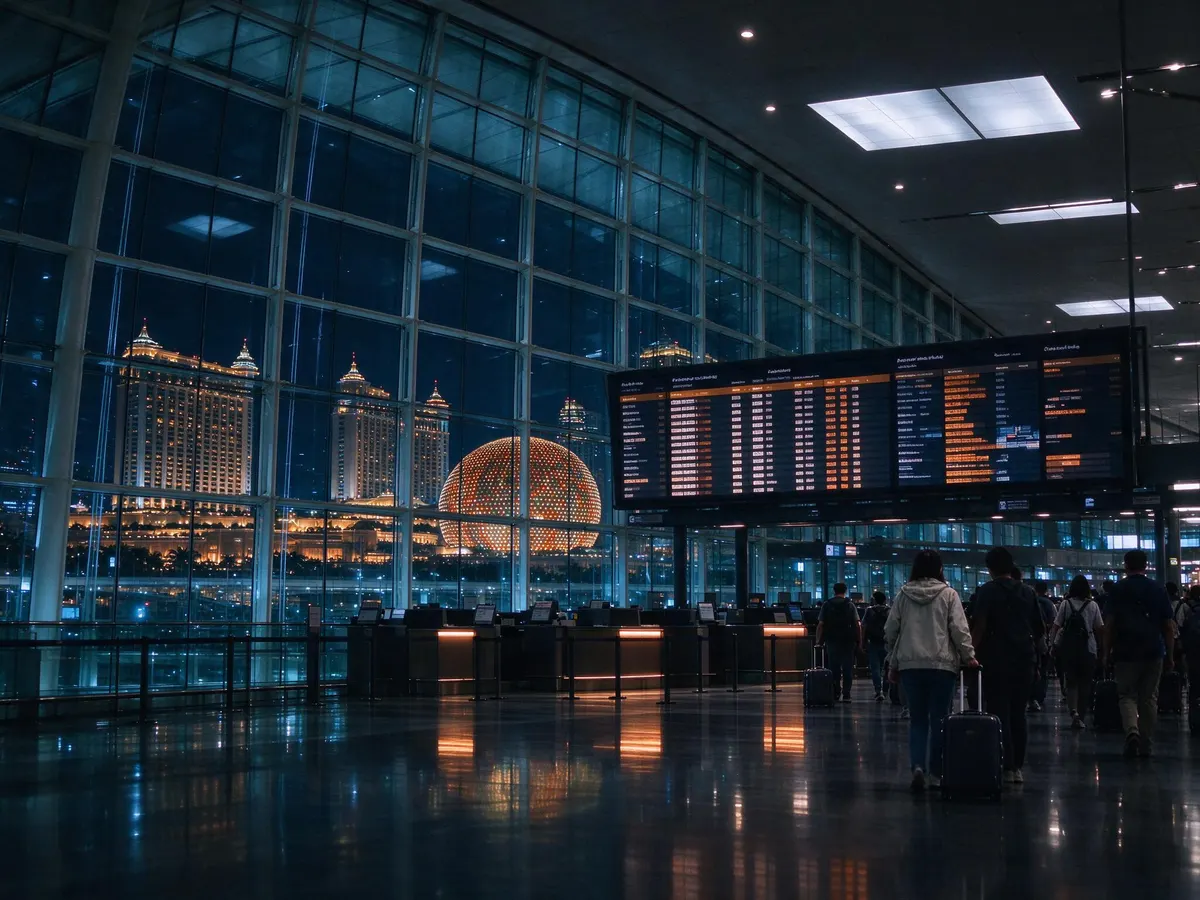
A Jeju Air flight lands at Manila at 11:40pm. Ninety minutes later, a party of four is checking into a hotel in Entertainment City, and one of them wanders down to look at the baccarat tables before bed. He plays for forty minutes, loses about the price of his flight, and goes to sleep. Multiply that scene by a few million and you have the business model behind most casino tourism destinations in Asia.
That is the connection the Philippine Department of Tourism’s forecast of 6.4 million international arrivals for 2026 is really describing. The tourism secretary framed it as a travel story, holding the target despite fuel price pressure. For resort operators in Manila, it reads as a volume input, because gaming revenue is a thin percentage taken from a very large flow of money, and the flow arrives on aeroplanes.
From the arrivals hall to the gaming floor
Casinos do not make money on bets. They make money on the mathematical edge applied to bets, repeated enough times for the average to show up. Baccarat, the game that dominates Asian gaming floors, carries a house edge of roughly 1.06% on the banker bet after commission and about 1.24% on the player bet. Slots typically run at 94% to 97% RTP, so a 4% house edge is on the generous side of normal.
Those are small numbers. A property needs enormous throughput before they turn into earnings, which is why operators obsess over footfall rather than individual outcomes. Hold percentage, what the house actually keeps from the chips bought at the table, is noisier in the short run than the theoretical edge, and noisier still when a handful of premium players account for a large slice of the volume. Volume smooths it out. Arrivals create volume.
The link between tourist arrivals and gaming revenue is not one-to-one, though, and anyone modelling it as a simple multiplier gets burned. The chain has several leaks:
- Not every arrival is a gaming visitor. A family heading straight to Palawan never sees a casino floor.
- Source market matters more than headcount. Visitors from markets with an established baccarat culture convert at a far higher rate than long-haul leisure travellers.
- Length of stay drives spend. A five-night stay in Manila produces several gaming sessions; a one-night transit produces none.
- Trip purpose decides the wallet. Conference delegates, returning overseas Filipinos and premium players on a dedicated gaming trip spend in completely different patterns.
Run the arithmetic yourself with your own assumptions and you see why operators care so much about the mix. If one in five of 6.4 million arrivals sets foot in an integrated resort, that is a little over a million gaming visits. Shift that conversion rate by a few percentage points, or shift the average spend per visit, and the revenue implication swings wildly. The forecast gives you the top of the funnel and nothing else.
What 6.4 million means for the Philippines casino market
Manila’s gaming cluster is unusual in Asia because it was built as a district rather than a single property. Entertainment City on Manila Bay holds Solaire Resort & Casino, City of Dreams Manila and Okada Manila within a short drive of each other, with Newport World Resorts sitting opposite the airport and Solaire Resort North extending the footprint into Quezon City. That geography is deliberate. Travellers landing at midnight can be on a gaming floor before 1am, which is worth more than it sounds when your target customer is on a three-night trip.
It also means the Philippines casino market is more exposed to aviation economics than almost any of its rivals. Nobody drives to Manila. Every incremental gaming visitor needs a seat on a plane, which is precisely why the fuel price caveat in the tourism department’s forecast is not a throwaway line. Higher jet fuel costs feed into airfares, airfares decide whether a short-haul carrier adds a Seoul or Osaka rotation, and seat capacity sets the ceiling on arrivals. The marginal leisure traveller is price sensitive in a way the premium player is not, so fuel pressure tends to thin the mass market end of the floor first.
Two other changes sharpen the stakes. The Philippines shut down its offshore gaming operator sector, removing a licensing revenue stream that had nothing to do with tourism and everything to do with regulatory tolerance. And the Manila airport’s operations passed to a private consortium with an upgrade mandate, which matters because terminal capacity and immigration queues are gaming infrastructure whether PAGCOR calls them that or not. With offshore licensing gone, the regulator’s domestic and tourist-facing revenue base carries more of the load. Arrival targets stop being a tourism statistic and start being a sector forecast.
Integrated resorts, and why the building is only half the business
Integrated resorts exist because pure casinos are fragile. Tie a gaming floor to hotel rooms, a theatre, retail, convention space and restaurants, and you capture spend from visitors who would never sit at a table, while giving gaming customers a reason to stay a fourth night. The non-gaming side also buys political cover, which is a real asset in jurisdictions where licences are renewed by governments that read opinion polls.
The dependency runs the other way too. An integrated resort is only as good as the infrastructure feeding it: direct flights from the right cities, visa arrangements that don’t deter the right nationalities, ground transport that gets a guest from kerb to lobby without an hour in traffic, and payment and currency systems that work for foreign visitors. Operators can build a tower in three years. They cannot build a runway, and they cannot legislate visa-free entry for their best source market.
The scoreboard for casino tourism destinations
Arrivals are necessary and nowhere near sufficient. The factors that separate strong casino tourism destinations from the ones that disappoint their investors tend to be structural:
- Accessibility and cost of getting there. Proximity to large source markets, seat capacity, airfare levels and entry formalities.
- Depth of the amenity offer. Enough non-gaming reasons to visit that the property is not hostage to one customer type.
- Regulatory stability. Predictable tax rates, licence terms long enough to justify capital spending, and an anti-money-laundering framework credible enough that international partners will deal with you.
- Quality of the visitor, not just the count. Premium mass and VIP play produce vastly more revenue per head, which is why destinations compete for high-value travellers rather than record arrival numbers.
- Competitive position. Whether you are the only licensed option in a region or one of five properties fighting over the same Korean and Japanese weekend traffic.
Junket operators used to be the mechanism for converting the fourth factor into revenue, extending credit and shuttling premium players across borders. That model has narrowed considerably across the region, and the operators who adapted best rebuilt direct premium mass marketing instead of waiting for the old pipeline to return.
Gaming tourism in Asia: everyone chasing the same visitor
Post-pandemic recovery in gaming tourism across Asia has been uneven in a way that reveals what each market actually depends on. Macau came back fastest in visitation terms because its customers can arrive by road and ferry from an adjacent market of enormous size, and its concession terms now push operators towards non-gaming investment. A direct rail link to the mainland also exists now: the Macau Light Rail Transit’s Hengqin Line, connecting Macau to Zhuhai, has commenced commercial operation. Singapore’s recovery leaned on two licensed integrated resorts, long-haul and regional air connectivity, and a deliberate policy of taxing local participation through an entry levy on citizens and permanent residents. The Philippines rebuilt with more properties, more competition and a thinner VIP pipeline.
| Hub | Primary visitation driver | Main structural constraint |
|---|---|---|
| Macau | Land, ferry and rail access from an adjacent mass market (LRT Hengqin Line now running to Zhuhai) | Dependence on a single source market and policy towards it |
| Singapore | Air connectivity plus a capped duopoly of integrated resorts | Restricted licensing and levies that limit local play |
| Philippines (Manila) | Short-haul North and East Asian air traffic, airport-adjacent resorts | Entirely air dependent; multiple properties sharing one city |
| Emerging markets (Japan, Thailand discussions) | Large domestic populations and tourism bases | Legislative and construction timelines measured in years |
That last row is the one Manila’s planners should watch. A single large integrated resort opening in a new Asian jurisdiction can redirect flight routes and premium travel patterns across the region, and the Philippines competes on price and accessibility rather than novelty. Holding 6.4 million arrivals would mean the top of the funnel is intact. Whether that converts into gaming revenue depends on who those visitors are, how long they stay, and how many competing floors are open by the time they land.
For readers who approach this from the player side rather than the investor side, the arithmetic cuts the other way: the revenue described here is money visitors lose, and the house edge guarantees that outcome over enough hands. Set a budget before you travel, treat it as entertainment spend, and use the deposit limits, time reminders and self-exclusion tools that licensed operators are required to provide.
Figures on the 2026 arrival target are drawn from reporting on the Philippine tourism secretary’s forecast published by GGRAsia; official arrival statistics are published by the Department of Tourism.