
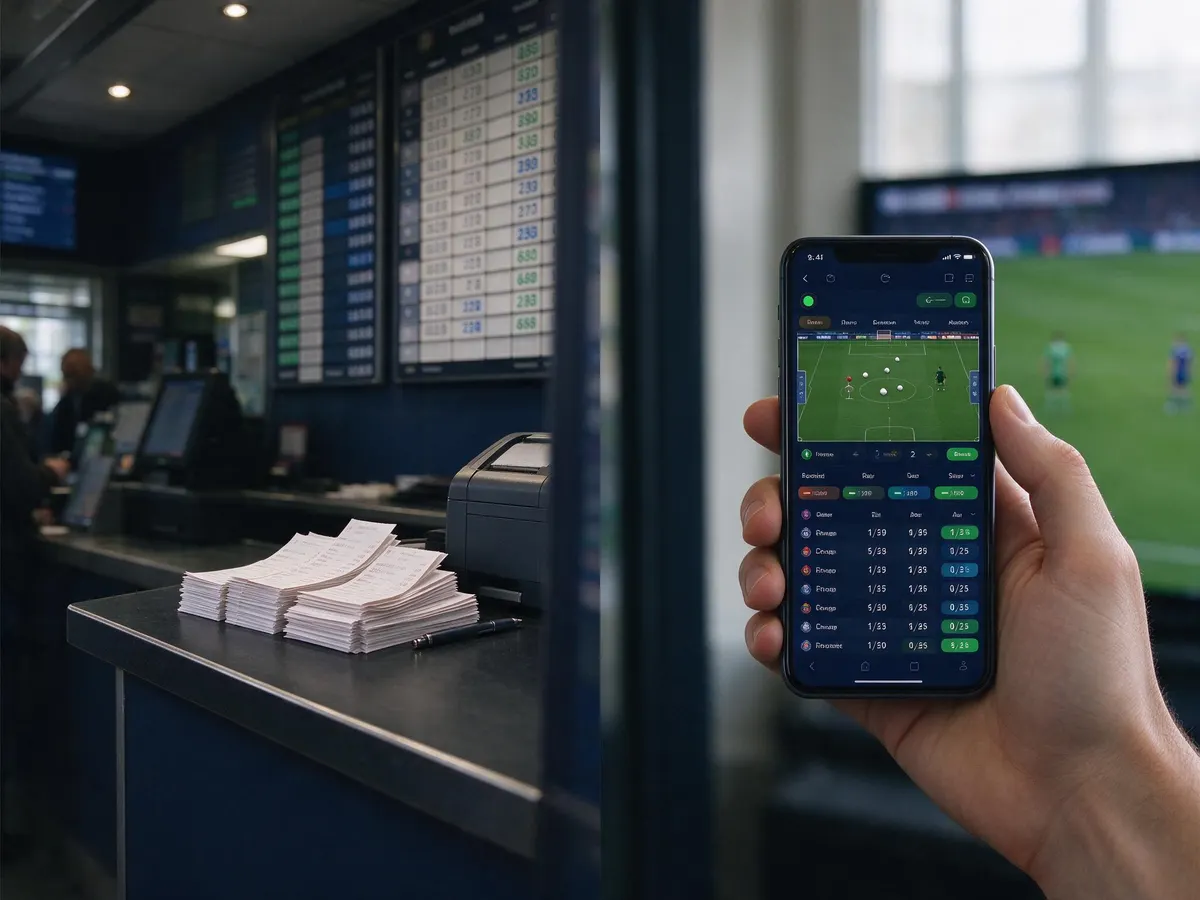
£995.6 million: the number that keeps the retail vs online betting debate alive
Betfred reported turnover of £995.6m for the 52 weeks to 29 March 2026, with gross profit of £720m and profit after tax of £39.6m. The interesting part isn’t the size of the number. It’s where the money came from: retail betting, the shops on the high street, remained the biggest contributor, in a market everyone assumes has already moved entirely to phones.
Both profit figures were well down on the previous report (£1.07bn gross profit, £128.8m profit after tax), and the company itself flagged that the two periods don’t line up neatly for comparison. It was also the last annual report filed before the UK’s Remote Gaming Duty increase in April, a tax that hits online revenue specifically. So the picture isn’t “retail is booming”. It’s more useful than that: the channel everybody writes off is still carrying the heaviest load, and the online side is the one facing a fresh tax bill.
If you’re an Indian punter trying to work out what any of this means for you, that’s the honest starting point. Retail and online are not old and new versions of the same product. They’re different products, with different costs, different limits, and a different relationship to your wallet. Here’s how to compare them properly, and then how to decide.
Step one: understand how the two betting channels actually differ
Strip away the branding and the differences come down to four things: where you are, how you pay, what you can bet on, and who you deal with when something goes wrong.
Walking in versus logging in
In a shop, the product is slow and physical. You read a printed board or a screen, fill in a slip, hand it over, get a paper receipt. That receipt is your bet. Nobody pushes a notification at you an hour later offering a bet builder on a match you weren’t watching.
Online, the product is instant and endless. Account, deposit, market, bet, all inside thirty seconds. In-play markets update every few seconds. The friction that a counter creates is gone, which is the main attraction and also the main risk.
How the money moves
Retail runs on cash. You stake notes, you collect notes, and a winning slip is usually paid over the counter immediately. There’s no withdrawal queue because there’s no withdrawal. Online runs on digital rails: UPI, cards, net banking, e-wallets, sometimes crypto on offshore sites. Deposits are typically near-instant; withdrawals depend on KYC checks and processing times, which can mean hours or days rather than seconds.
That gap matters more than people expect. A shop punter never has a payout held pending document verification. An online punter never has to carry cash home.
Limits, markets and prices
A shop is constrained by physical space and staff. Fewer markets, simpler bets, lower practical limits, and the odds you see are the odds you get. Online, the market depth is the selling point: hundreds of cricket and football markets, player props, in-play, cash-out, live streaming, and prices you can compare across sites in a minute.
Online pricing is usually sharper, because the competition is one tab away. That doesn’t mean the margin disappears. A two-way market priced 1.90 / 1.90 implies 52.6% probability on each side, 105.3% in total, so roughly a 5% overround baked into the prices. Retail margins tend to be wider still. Over time, that built-in edge is how bookmakers make money in both channels. No channel changes that arithmetic.
| Factor | Retail betting shop | Online sportsbook |
|---|---|---|
| Access | Fixed location, opening hours | Anywhere, any hour, mobile-first |
| Payments | Cash in, cash out | UPI, cards, net banking, e-wallets |
| Payout speed | Immediate over the counter | Minutes to days, subject to KYC |
| Market depth | Limited, headline markets | Very wide, including in-play and props |
| Odds comparison | Not practical | Easy across multiple sites |
| Promotions | Rare, simple | Frequent, with wagering requirements |
| Human support | Face to face | Chat, email, sometimes phone |
| Spend tracking | Manual, you count the cash | Full digital history, built-in limit tools |
Step two: see why betting shops still pull people through the door
“Why do betting shops still exist?” is a fair question when an app does more for less. The answer is that a shop sells things an app structurally can’t.
- Cash, with no paper trail to a bank account. For customers who don’t want gambling transactions on a statement, or who are paid in cash, retail is the only option.
- Instant settlement. Winning slip, cash in hand. No verification email, no pending status, no payout limit per 24 hours.
- A person to argue with. Disputes get resolved at the counter by someone who can look at your slip. Online, you’re in a chat queue.
- Friction as a feature. Having to walk somewhere, during opening hours, naturally caps how much you bet. Several experienced punters I know use a shop precisely because it’s inconvenient.
- Social habit. A race meeting or a big match in a room full of other people is a different experience from a solo phone session. That atmosphere is the product for a decent chunk of the customer base.
- Trust and visibility. A licensed premises with a staffed counter reads as accountable in a way an unfamiliar website doesn’t, especially to older customers.
That bundle explains the Betfred split. Retail customers tend to be loyal, cash-based, lower-churn and far cheaper to retain than online ones, which is why the shops still out-contribute the digital arm despite every trend line pointing the other way.
Step three: weigh what the online sportsbook does better
Plenty, and it’s not close on some measures.
Market depth first. An online book can offer every IPL match, every Premier League game, kabaddi, tennis, esports, plus in-play markets that only exist because a server can reprice in milliseconds. A shop can’t stock that inventory.
Then price. Comparing odds across three or four sites takes a minute and genuinely reduces the margin you’re paying. Retail gives you one price, take it or leave it.
Then the tooling. Live streaming inside the bet slip, cash-out, full bet history, and, importantly, built-in responsible gambling controls: deposit limits, loss limits, session reminders, cool-off periods and self-exclusion. A cash counter offers none of that.
Promotions sit in the plus column with an asterisk. Free bets and matched deposits are real value only if you read the terms. A “100% up to ₹10,000” offer with 30x wagering means ₹3,00,000 must be staked before the bonus balance converts, and game weighting may mean some bets contribute less than 100%. Treat a bonus as a discount on what you were going to bet anyway, never as free money.
Step four: look at the operator’s maths, because it shapes what you’re offered
The two channels are completely different businesses wearing the same logo.
A retail estate carries fixed costs: rent, rates, utilities, security, and staff on shift whether twenty customers walk in or two hundred. Those costs don’t scale down in a quiet week. What retail gets in return is cheap customer acquisition. The shopfront is the marketing, footfall is the funnel, and regulars come back for years without being paid a bonus.
An online sportsbook flips that. The marginal cost of one more customer is close to zero, which is why digital arms can grow fast. But acquisition is brutally expensive. Affiliate commissions, performance marketing, sponsorships and welcome offers all compete for the same signup, and customer acquisition costs rise every time a new competitor enters. Add platform and data feed fees, payment processing, fraud screening and the compliance and KYC burden that sits on every account.
Tax is the variable that moves fastest, and it’s channel-specific. The UK’s Remote Gaming Duty increase in April landed on online revenue, not shop counters. In India, the tax burden on online real-money play has gone the other way from bettor-friendly: GST applies on deposits for online money gaming, and winnings are taxed with TDS on net winnings. Specifics change, so treat that as informational rather than tax advice and check the current position before you assume anything about your returns.
The practical result for you: online offers better prices and bigger bonuses because it has to buy you, while retail offers service and immediacy because it has already got you.
Step five: factor in the trends that are merging the two
Four shifts are worth tracking.
Mobile is now the default, not a channel. Desktop sportsbook design is an afterthought. Products are built for a thumb, which drives shorter sessions and more frequent bets.
In-play betting keeps taking share from pre-match. Live markets, ball-by-ball cricket pricing and cash-out are where digital growth concentrates. Retail simply cannot compete here.
Crypto deposits have grown, mostly offshore. They bring faster settlement and, often, far weaker consumer protection and dispute resolution. Speed is not the same as safety.
Omnichannel is the operators’ answer. One account, one wallet, bet in the shop and track it on the app, or deposit cash over a counter and play on your phone. That’s the direction serious retail operators are taking, and it’s the reason “retail is dying” was always too simple.
The likely future for both formats is fewer shops but not zero shops, with the surviving estate serving cash customers, social occasions and major events, while online absorbs everything that benefits from speed and depth.
Step six: pick the channel that fits you, in the Indian context
Neither channel is better in the abstract. Work through this in order.
- Check what’s legal where you are. India regulates gambling largely at state level under the Public Gambling Act framework, and the rules genuinely differ. Licensed physical venues exist in a handful of places, Goa and Sikkim among them, and on-course betting on horse racing has been treated differently from games of chance by the courts. Online real-money gaming has faced tightening restrictions at both state and central level in recent years. This is the part people skip and shouldn’t. Verify the current position in your state before you bet anything.
- Decide how you want to pay. If you want cash and instant payout, that points to a licensed physical venue where one is lawfully available. If you’re comfortable with UPI, KYC and a 24 to 72 hour withdrawal window, online is built for you.
- Match the channel to your betting style. One considered bet a week on a cricket result? A shop or a simple app both work. Live markets, player props and odds comparison? Only online delivers that.
- Read the terms before the bonus. Wagering requirements, max bet while a bonus is active, max cashout and game weighting decide whether an offer is worth anything.
- Set your limits before your first bet, not after a bad week. Deposit and loss limits, session reminders and cool-off tools exist on regulated online sites. Use them. If you’re betting in cash, set a hard physical budget and leave the cards at home.
- Keep records. Online gives you a full history automatically. In cash, you have to do the bookkeeping yourself, and you should, both for tax and for an honest view of how you’re actually doing.
One thing applies to every channel, every market and every price: the margin is built in, so the longer you play, the more the maths favours the operator. Betfred’s filing is a reminder of that from the other side of the counter. Bet money you can afford to lose, treat it as entertainment spending rather than income, and if it stops feeling like a choice, use the self-exclusion and cool-off tools or contact a support service. Our responsible gambling guide covers those options, and if you’re still deciding where to bet at all, start with the fundamentals in our betting basics explainer and our overview of online betting sites in India.