
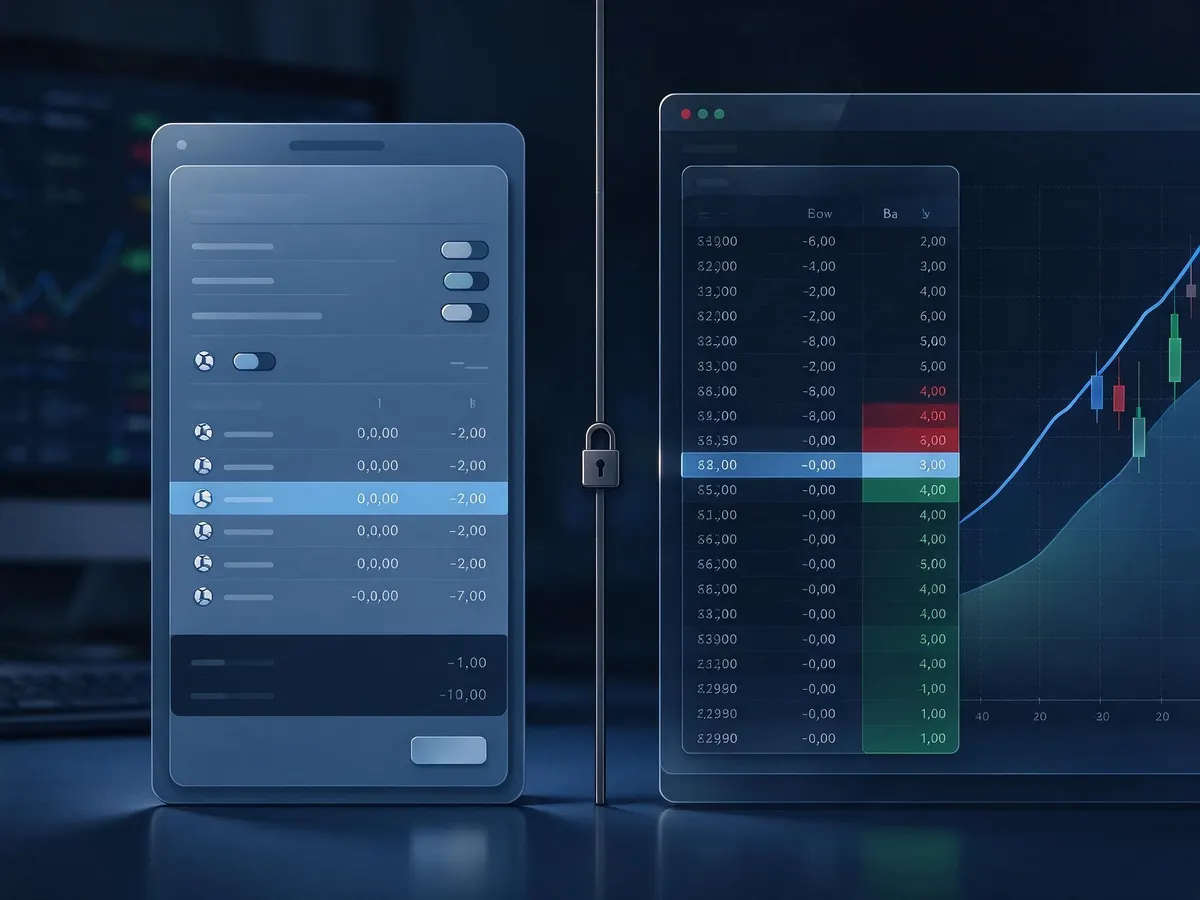
Two tabs open on the same phone. In one, a sportsbook quoting 1.85 on a team to win. In the other, a prediction market where the same outcome trades at 54 cents, with an order book, a price chart, and a button marked “sell” next to the one marked “buy”. Same event, same opinion, two completely different products in the eyes of a regulator.
That gap is what the US Commodity Futures Trading Commission has just tried to formalise. The practical question for anyone comparing prediction markets vs gambling is simple: which rulebook covers the money you put in, and what does that rulebook actually give you? The answer matters more than the interface does.
What the CFTC rule defines as prediction markets versus gambling
On October 9 the CFTC issued an interim final rule excluding qualifying traditional gambling products, including sportsbook wagers and casino games, from the federal definition of a swap. The rule takes effect on publication in the Federal Register and opens a 30-day public comment period, so the wording can still shift before it settles.
The short version: a bet placed with a licensed bookmaker is a bet, not a derivative. An event contract traded on an exchange stays inside the CFTC’s world of commodity futures and financial instruments. The regulator drew the line not by looking at what you are predicting, but at who offers the product and how the transaction is executed.
Event contracts versus gaming contracts
Two conditions do most of the work in the carve-out. First, the product must be offered by an operator licensed under state law or by a federally recognised tribe, and regulated as gambling under that applicable legal framework. Second, the transaction cannot take place on an organised exchange or any other market where multiple parties negotiate or execute trades.
Read those together and the logic becomes clear. A sportsbook is a counterparty: you bet against the house at a price the house sets. A prediction market is a venue: you buy a contract from another participant, and the platform matches you. The moment multiple parties are negotiating and executing against each other in an organised market, you are no longer inside the gambling carve-out, and the derivatives regime applies.
This is also why the same underlying question can live in both worlds. “Will this team win?” can be a gaming contract at a licensed sportsbook and an event contract on a registered exchange. The subject matter is not the test.
The economic purpose question
Behind the mechanics sits a longer-running argument about economic purpose. Derivatives regulation exists because futures and swaps let people hedge real exposures and because exchange prices aggregate information into a usable signal. A wheat farmer hedges a harvest. An airline hedges fuel. The price everyone sees becomes a reference point.
Prediction markets claim a version of that: a contract on an election result, an interest rate decision, or a weather outcome can hedge a genuine business risk, and the traded price works as a probability estimate. Critics argue that for most retail participants on most sports contracts, there is no exposure being hedged and no price discovery worth defending, just speculation with a trading skin on it.
The CFTC has never accepted event contracts without limits. It retains authority to review contracts tied to gaming, unlawful activity, and similar categories it judges contrary to the public interest. The interim final rule does not resolve that debate. It settles a narrower point: licensed gambling products are not swaps, so sportsbooks and casinos are not accidentally pulled into federal derivatives rules.
How prediction markets work differently from traditional betting
Put the two side by side and the mechanical differences are easy to feel within five minutes of use.
Pricing and liquidity
A bookmaker quotes fixed odds with a built-in margin, the overround. Convert 1.85 and 1.95 on a two-way market into implied probabilities and they sum to more than 100%; the surplus is the operator’s edge. You accept the price or you walk away.
A prediction market price is set by participants. A contract trading at 54 cents that pays 1 dollar if the event happens carries an implied probability of roughly 54%, moving tick by tick as orders arrive. Instead of a margin baked into the odds, the platform typically charges trading or settlement fees, and you face a bid-ask spread that widens when liquidity is thin. Thin markets are the real cost here: on an illiquid contract, getting in and out can hurt you far more than a headline fee.
Trading versus betting
The structural difference is exit. A placed bet is locked until settlement unless the operator offers cash out at a price of its choosing. A prediction market position can be sold at the prevailing market price at any time, which turns the exercise into position management rather than a single resolved wager. You can be right about the outcome and still lose money by trading badly, or wrong about the outcome and close the position at a profit after a favourable price swing.
| Feature | Fixed-odds betting | Prediction market event contracts |
|---|---|---|
| Counterparty | The operator | Other participants, matched by the venue |
| Price formation | Set by the operator, margin included | Set by order flow, expressed as a probability |
| Operator revenue | Overround on the odds | Trading and settlement fees, spread |
| Exiting early | Only if cash out is offered | Sell the position at market price |
| Regulator (US) | State gambling authorities, tribal regulators | CFTC, as derivatives |
| Stated purpose | Entertainment | Hedging and price discovery, with speculation present |
What the distinction means for platform access
Regulatory classification decides who may legally offer a product, to whom, and under what obligations. That is the part players feel.
Licensing paths diverge
Under the US framework, a sportsbook needs a state licence or tribal authorisation, state-by-state, with gambling-specific duties attached: age verification, advertising rules, responsible gambling tools, taxation under state law. An event-contract venue takes the derivatives route, registering with the CFTC and operating under exchange and reporting requirements built for financial markets.
Neither path is a shortcut. They impose different obligations, and the interim final rule means an operator cannot drift between them by accident. The carve-out also explains a quieter point: if a gambling product were treated as a swap, it would face registration demands designed for financial institutions, which is a problem nobody in the industry wanted.
Cross-border reality for Indian players
This is a US rulebook, and that is exactly why Indian readers should read it carefully rather than hopefully. A CFTC-registered exchange answers to US law and verifies users against that framework. Access from outside the United States is commonly restricted, and where it is not, the protections attached to US registration are not designed to follow you home. Nor does an American classification change anything about Indian law.
In India, the Promotion and Regulation of Online Gaming Act, 2025 prohibits online real-money gaming nationally, so the question is not which licence a platform holds but whether the activity is permitted at all. Tax treatment is separate again: winnings from online gaming are taxable, with tax deducted at source on net winnings, and GST applies at the operator level. Rates and definitions have moved more than once, so check the current position with a qualified adviser rather than a forum post.
The honest takeaway: a label of “prediction market” or “regulated derivative” earned in Washington does not make a platform lawful or protected for a user in Mumbai. Jurisdiction is where the protection lives.
Practical considerations before you choose a platform
Risk and return profiles
Both carry a negative expected value for the typical participant, just assembled differently. In betting, the operator’s margin is in the odds, and the house edge works steadily against you over volume. In prediction markets, the cost is fees plus spread plus your own execution: a 2 or 3 cent spread on a contract priced at 50 cents is a meaningful drag, repeated on every round trip.
Payout shapes differ too. A sportsbook bet resolves once. An event contract can be closed early, which lets you cut a losing position but also tempts over-trading, and intraday price moves can be violent around news. Neither structure removes variance, and neither is a route to reliable income. Anyone telling you a market-based interface converts gambling into investing is selling something.
Consumer protections
Here the frameworks genuinely diverge, and it is worth knowing what you are trading away.
- Licensed gambling regimes typically mandate the tools built for problem gambling: deposit and loss limits, session reminders, cool-off periods, self-exclusion, plus dispute channels through the gambling regulator.
- Derivatives regimes focus on market integrity: exchange rules, position reporting, customer fund handling, surveillance against manipulation. Strong on fairness of the market, far lighter on protecting a user from their own trading frequency.
- Unlicensed offshore platforms often advertise whichever label sounds most legitimate while sitting outside both frameworks. That is the scenario with the least recourse if a withdrawal stalls or an account is closed.
So: does a prediction market offer an advantage over traditional gambling for an Indian player? If you have a genuine exposure to hedge and lawful access to a regulated venue, the economic case is real. For most readers, what is on offer is a different cost structure, a visible probability price, and an exit button, wrapped in a regime that was never built to look after a retail speculator’s habits. That is a trade-off, not an upgrade.
Whichever side of the line a platform sits on, treat the money you put in as money you can afford to lose, set your own limits before you start, and use the self-exclusion and cool-off tools if the activity stops feeling like a choice. Support services for gambling-related harm are available in India and are worth contacting early rather than late.